The site of Chesterfield was first occupied as a Roman fort, established around AD 70 on the Roman road north from Derventio (Derby). The Old English place-name Cestrefeld, ‘fort field’, preserves the memory of that fortification. A Saxon and then Norman settlement followed at or near the same site; by the twelfth century there is evidence of an organised market, and on 9 May 1204 King John granted the borough its market charter, allowing the holding of a weekly market and an annual fair. The medieval town was relayed out at this point, drawing the centre of gravity slightly westward of its earlier core around the parish church.
Construction of the present Church of St Mary and All Saints, the largest parish church in Derbyshire, was begun in the late thirteenth century and substantially completed by around 1360, in a mixture of Early English, Decorated and Perpendicular Gothic. The wooden lead-clad spire was added some years later, almost certainly after the Black Death of 1349, and quickly began to twist on its frame in a way that has continued, slowly and unstoppably, ever since.
The medieval and early modern town developed steadily around the market and the cloth trade. Revolution House, a small thatched seventeenth-century alehouse (formerly the Cock and Pynot) at Old Whittington on the northern edge of the town, was the meeting place in 1688 at which three local Whig nobles — William Cavendish, fourth Earl of Devonshire (later first Duke of Devonshire of Chatsworth), Thomas Osborne, Earl of Danby, and John D'Arcy — conferred on the invitation to William of Orange that became the Glorious Revolution. The cottage is preserved by Chesterfield Borough Council and operates as an occasional museum.
Chesterfield's industrial transformation came with the railway. George Stephenson, the engineer of the Stockton and Darlington and Liverpool and Manchester Railways, settled in Chesterfield in 1838 to oversee construction of the North Midland Railway, which ran south from Leeds to Derby through the town. During the cutting of the Clay Cross tunnel south of Chesterfield, a substantial seam of coal was discovered; Stephenson founded the Clay Cross Company to work the seam, and lived at Tapton House on the eastern edge of the town until his death in 1848. He is buried at Trinity Church on the Newbold Road.
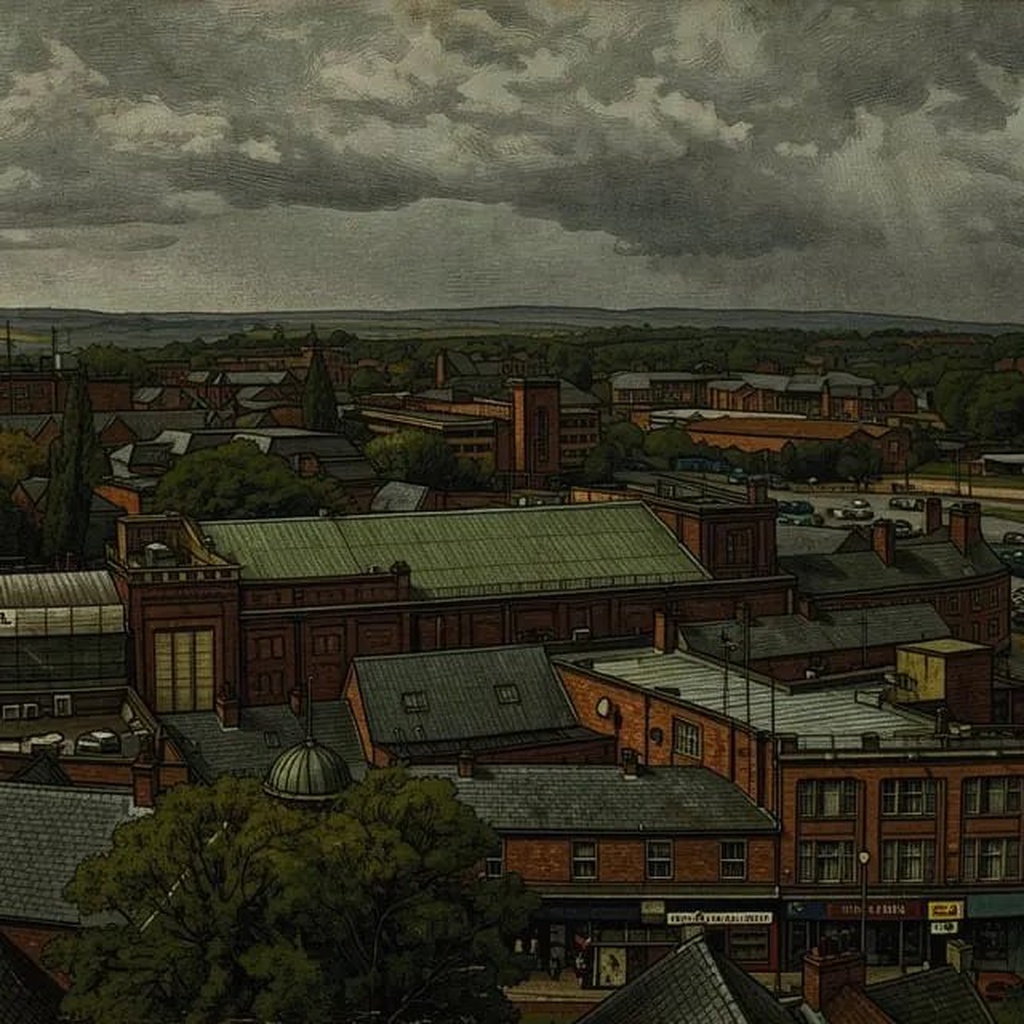
The discovery of the coalfield, and the railway running directly through it, transformed Chesterfield through the second half of the nineteenth century into a centre of mining, iron-founding and heavy engineering. By 1900 a ring of collieries surrounded the town — Markham, Bolsover, Glapwell, Clay Cross, Williamthorpe, Pleasley, Whitwell — supplying coal to the railway, the local ironworks, and the wider national grid. The town's growth in this period followed the contours of the coalfield: the terraced colliery villages along the valley roads, the Miners' Welfare clubs, the Methodist chapels, the Co-operative stores. The economic and social character of north-east Derbyshire was, for nearly a century, the character of a coalfield.
The dismantling of that economy in the late twentieth century was abrupt. The 1984–85 miners' strike, which was prosecuted with particular intensity in Derbyshire, was followed by a programme of pit closures over the next decade that ended local deep coal mining altogether. By the time the events of Cambion open in 1995, the last Derbyshire deep mine has closed within the previous twelve months; the social and economic dislocation that followed the closures is still recent, and the colliery villages have not yet found a new economic basis to replace the one that has been taken from them.
The spire of the Church of St Mary and All Saints rises to two hundred and twenty-eight feet above the ridge of high ground at the centre of the town. It is octagonal in plan, of timber framing covered with lead, and from its base it twists — visibly, dramatically, in a way no straight observation can entirely accommodate — through approximately forty-five degrees in a clockwise spiral, leaning some two and nine-tenths metres (nine feet six inches) from the vertical at its tip. It is, by some considerable margin, the most strikingly distorted church spire in Britain, and one of the most photographed.
The structural cause is reasonably well understood. The medieval builders used timber that was insufficiently seasoned — green oak, which then dried unevenly under the load of the roughly thirty-two tonnes of lead tiles which clad the structure. The cross-bracing was inadequate to compensate for the asymmetric drying of the timbers under that load. The lead, expanding under solar heating on the south face and contracting on the cool north face through every diurnal cycle for the first several centuries of the spire's life, took the warping further. By the time anyone understood that the spire was no longer simply settling but undergoing a continuous structural process, the process had committed and could not be undone.
Folklore, in this case, prefers a more interesting account. One tradition holds that the devil, perching on the spire to rest mid-flight, was so startled by the smell of incense rising from the church beneath him that he twisted in the air and gave the spire its kink. Another account, cited locally with appropriate civic gravity, holds that a virgin came to the church to be married, and the spire, astonished beyond all credit, bent down to look. Neither account has any historical substance. They are nonetheless good stories, and a town with a six-hundred-year-old visibly impossible church spire is allowed its better stories.
A fire on 22 December 1961 broke out in the north transept and threatened the entire structure for two hours before being brought under control. The spire survived. The cost of the damage was around £30,000 and was made good within a few years. The Crooked Spire continues to lean, in essentially the same posture it has held for six centuries, over the market place beneath it.
The Chesterfield Market — held in the cobbled market place at the centre of the town since the borough charter of 1204 — is one of the largest open-air markets in England and has run, in some form, for more than eight centuries. The Victorian Market Hall (1857) anchors the western side of the square. The covered Shambles, narrow medieval alleys lined with butchers' and small traders' premises, run off the south side and preserve the burgage-plot layout of the medieval borough.
The town's industrial heritage is unusually intact for a place that has lost almost all of its primary industries. Tapton House, George Stephenson's residence, survives as a public park; Revolution House at Old Whittington is a small museum; the Chesterfield Canal, built between 1771 and 1777 by James Brindley and others to carry coal and lead to the Trent, has been progressively restored from the late twentieth century onwards as a recreational waterway. The town's former Co-operative buildings, Miners' Institutes, and railway-engineering works survive in considerable numbers, in various states of repurposing.
Queen's Park, on the south side of the town, has hosted Derbyshire County Cricket Club fixtures since 1898; both W. G. Grace (in 1904) and Don Bradman (in the 1930s) played cricket there. The park is generally regarded as one of the more attractive county-cricket grounds in England.